
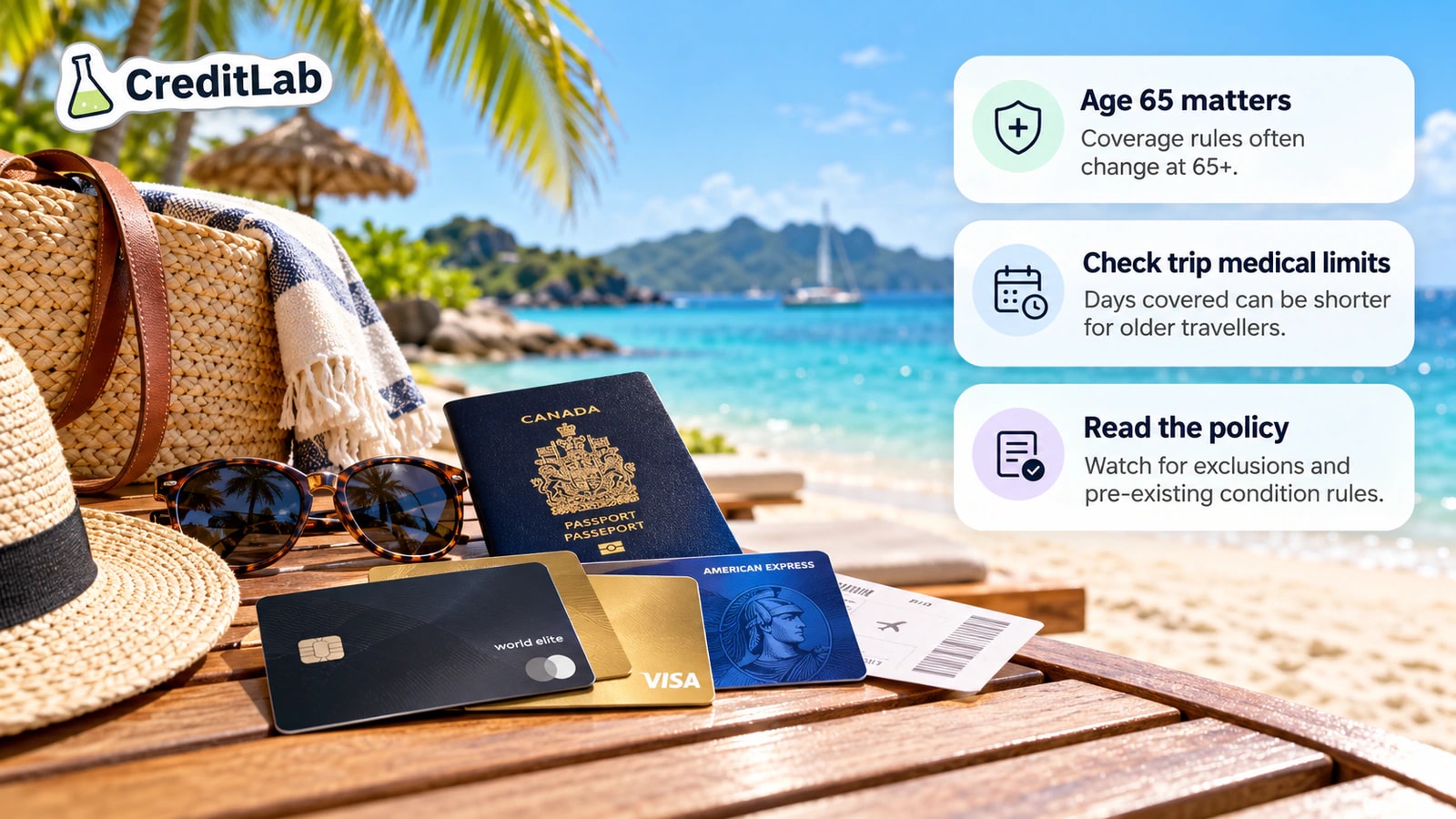
- Under 65, the six certificates we read cover the first 15 to 60 consecutive days of a trip, depending on the card and your age.
- At 65, cover drops to 3 or 4 days on four of the six cards. CIBC Aeroplan Visa Infinite Privilege keeps 10 days and National Bank World Elite keeps 15.
- Several certificates cover nothing on a trip that runs past the day limit, and say to buy separate insurance for the extra days.
- None of the six certificates requires the trip to be charged to the card for emergency medical cover. Trip cancellation does, though most accept the card’s own points.
Checked October 2026
What does your provincial health plan pay abroad?
Very little. Travel.gc.ca says your provincial or territorial plan “may cover none, or only a small part” of medical costs abroad. B.C.’s plan, for example, pays at most $75.00 a day in Canadian funds for emergency hospital care outside Canada. You pay the rest.
That gap is what credit card travel insurance is built to fill. Your provincial plan still matters, though: every certificate we read pays only the amount left over after your government health insurance plan and any other insurance have paid. To be covered at all, you have to be enrolled in a provincial or territorial plan for the whole trip.
The B.C. figure is a useful reference point. The province says it provides some coverage for emergency hospital care outside Canada, but limits it to a maximum daily payment of $75.00. Any amount above that is the patient’s responsibility. Doctors’ bills are paid at no more than what the same service would have cost in B.C., and the province advises buying extra medical insurance from a private insurer.
Other provinces publish their own out-of-country rules, and they differ. We quote B.C. because its rate is published on a government page we could check. Whatever province you live in, the practical point is the same: the card’s certificate, not your health card, decides most of what gets paid.
How many days does credit card travel insurance cover?
It depends on your age on the day you leave. Under 65, the cards we read cover the first 15 to 31 consecutive days of a trip, and National Bank covers 60 days up to age 54. At 65, four of the six cards drop to 3 or 4 days.
Every certificate counts days the same basic way. The clock starts on the day you leave your province, and the departure day counts as a full day. Your age is taken on the departure date. If you turn 65 halfway through a trip, the certificates we read use the age you were when you left.
| Card | Under 65 | 65 and over | Notes |
|---|---|---|---|
| TD First Class Travel Visa Infinite | 21 days (64 and under) | 4 days | Extension can be bought from TD’s administrator |
| Scotiabank Passport Visa Infinite+ | 25 days | 3 days | Scotia Travel Extension Coverage can be bought |
| RBC Avion Visa Infinite | 15 days | 3 days | Top-up can be bought from RBC’s Enrollment Centre |
| CIBC Aeroplan Visa Infinite Privilege | 31 days (64 and under) | 10 days | Same days from age 65 on in this certificate |
| BMO eclipse Visa Infinite Privilege | 22 days (64 and under) | 3 days | Trip doesn’t need to be charged to the card |
| National Bank World Elite Mastercard | 60 days to age 54; 31 days at 55 to 64 | 15 days at 65 to 75 | No coverage at 76 and over |


Days are consecutive and include the departure day. Source: each card’s certificate of insurance, checked October 21, 2026.
Short of a 14-day trip at 65+ TD First Class Travel Visa Infinite
Short of a 14-day trip at 65+ Scotiabank Passport Visa Infinite+
- Short of a 14-day trip at 65+
Short of a 14-day trip at 65+ CIBC Aeroplan Visa Infinite Privilege
Short of a 14-day trip at 65+ BMO eclipse Visa Infinite Privilege
Each panel uses the same scale. The dashed line across is a 14-day trip; the dashed line down is age 65. Figures from each issuer’s certificate of insurance.
The drop at 65 is the single largest change in these certificates. On the Scotiabank Passport Visa Infinite+, cover falls from 25 days to 3, which is 22 fewer days. On the TD First Class Travel Visa Infinite it falls from 21 to 4. On the BMO eclipse Visa Infinite Privilege it falls from 22 to 3. On the RBC Avion Visa Infinite it falls from 15 to 3.
Two cards hold up better. The CIBC Aeroplan Visa Infinite Privilege keeps 10 days at 65 and over. The National Bank World Elite Mastercard keeps 15 days from 65 to 75, but its certificate stops emergency medical cover entirely at 76.
Here’s how that plays out. A 65-year-old with the TD First Class Travel Visa Infinite takes a 14-day trip. The card covers the first 4 days. The remaining 10 days need other insurance. At 64, the same trip would sit inside the 21-day limit.
Age 75 is the other line to look for. Of the six certificates we read, National Bank’s is the only one that ends medical cover at an age, at 76. Scotiabank and RBC use 75 as the age where the look-back period for pre-existing conditions gets longer, which the section on stability covers below.
What do the certificates actually say?
Each certificate names the insurer, the maximum payout, the day limits, the look-back period for existing conditions, what triggers cover and how fast you must report a claim. The table below puts those terms side by side, with the effective date printed in each document.
| Card | Underwriter (as named) | Emergency medical max | Days by age band | Stability period | Does medical need the trip charged? | Claim notice rule | Certificate effective date |
|---|---|---|---|---|---|---|---|
| TD First Class Travel Visa Infinite | TD Life Insurance Company | $2,000,000 per insured person per trip | 21 days at 64 and under; 4 days at 65 and over | 90 days at 64 and under; 180 days at 65 and over | No; account in good standing | Report within 48 hours of hospital admission; claim within 1 year | Not stated in this certificate |
| Scotiabank Passport Visa Infinite+ | The Manufacturers Life Insurance Company (Manulife) | $2,000,000 per insured person | 25 days under 65; 3 days at 65 and over | 180 days under 75; 365 days at 75 and over | No; account in good standing | Contact the administrator without delay; written notice within 90 days | July 1, 2021 |
| RBC Avion Visa Infinite | RBC Insurance Company of Canada | Unlimited, unless otherwise noted | 15 days under 65; 3 days at 65 and over | 90 days under 75; 180 days at 75 and over | Not stated in this certificate; cover ends if the account is 60 days past due | Call before treatment; notice within 30 days; details within 90 days | Not stated in this certificate |
| CIBC Aeroplan Visa Infinite Privilege | Belair Insurance Company Inc. | $5,000,000 per insured person per trip | 31 days at 64 and under; 10 days at 65 and over | 90 days; 180 days at 65 and over | Not stated in this certificate; cover ends if the account isn’t in good standing | Contact Global Excel before treatment; claim within 90 days of service | July 1, 2025 |
| BMO eclipse Visa Infinite Privilege | CUMIS General Insurance Company | $5,000,000 per insured person per trip | 22 days at 64 and under; 3 days at 65 and over | 90 days; 180 days at 65 and over | No; certificate says so if the account is in good standing | Notify within 24 hours if admitted to hospital; written notice within 30 days; proof within 90 days | Group policy effective July 6, 2023 |
| National Bank World Elite Mastercard | National Bank Life Insurance Company (Canassurance, Insurance Company for Alberta residents) | $5,000,000 per insured person per trip | 60 days to 54; 31 days at 55 to 64; 15 days at 65 to 75; none at 76 and over | 3 months under 61; 6 months at 61 and over | Not stated in this certificate | Call before incurring expenses; claim form within 30 days; documents within 90 days | Group policy effective September 1st, 2017; document dated 2024 |
“Not stated in this certificate” means we didn’t find the term in the document we read, not that the term doesn’t exist. Checked October 21, 2026.
Three things stand out. First, the dollar maximums cluster at $2,000,000 or $5,000,000, and RBC’s is unlimited unless otherwise noted. For most emergencies on a short trip, any of those is enough, so the maximum rarely decides which card covers you.
Second, the underwriter is often not the bank. TD’s cover comes from TD Life Insurance Company and RBC’s from RBC Insurance Company of Canada, but Scotiabank’s comes from Manulife, CIBC’s from Belair and BMO’s from CUMIS. The claims line you call is often a third company again, such as Global Excel or Allianz Global Assistance.
Third, two of the six certificates print no effective date for the medical section. The TD guide we downloaded prints dates on some of its other certificates but not the medical one, and RBC’s medical certificate prints none at all. Certificates change. The issuer can amend or cancel cover, and the version that applies is the one in force when you travel.
What counts as a pre-existing condition?
It’s a condition you had before the trip that wasn’t “stable” for a set period before you left. Each certificate defines stable as a list of tests. Fail one test in the look-back window and claims linked to that condition can be refused.
Some comparison pages say no card covers pre-existing conditions. The certificates are more nuanced. Most cover a condition you already have, as long as it met every stability test for the full look-back period. What changes from card to card is the length of that period and the exact tests.
TD’s certificate lists seven statements that must all be true for a condition to count as stable. RBC’s uses the same seven. Paraphrased, they are:
- No new treatment prescribed or recommended, and no change to existing treatment, including stopping it
- No change to any prescribed drug, including a higher dose, a lower dose or stopping it, and no new prescription
- The condition hasn’t become worse
- No new, more frequent or more severe symptoms
- No hospital stay and no referral to a specialist
- No tests, investigation or treatment recommended but not yet done, and no test results still outstanding
- No planned or pending treatment
Both list exceptions. TD treats routine adjustment of Coumadin, warfarin or insulin as stable, as long as the drug wasn’t newly started or stopped, and also allows a switch from a brand-name drug to a generic at the same dose. CIBC’s certificate uses five tests and adds oral diabetes medication to the routine-adjustment exception.
The look-back period is where age comes back in. TD, CIBC and BMO look back 90 days if you’re under 65 and 180 days at 65 and over. RBC looks back 90 days under 75 and 180 days at 75 and over. National Bank looks back 3 months under 61 and 6 months at 61 and over.
Scotiabank’s Passport Visa Infinite+ certificate works differently. Its definition looks back 180 days if you’re under 75 and 365 days at 75 and over. For emergency medical cover, though, it carves out a condition “controlled by the consistent use of medications prescribed by a Doctor”. That carve-out holds only if, in the look-back period before departure, no other treatment or investigation was recommended and the medication didn’t change. A new drug or a dose change counts as a change.
Travel.gc.ca suggests getting written confirmation that your insurance covers any pre-existing condition. The claims lines printed in each certificate are where those questions go, and most certificates say your medical history may be reviewed after a claim is reported.
Must you charge the trip to the card?
For emergency medical cover on the cards we read, no. Cover depends on holding the card with the account in good standing. For trip cancellation and interruption, yes: the certificates require the trip costs to be charged to the card, and most also accept the card’s points.
This is the rule people most often get backwards, because the trigger changes from one benefit to the next inside a single certificate. BMO’s says it directly: the trip does not need to be charged to the card for emergency medical benefits, as long as the account is in good standing.
TD’s and Scotiabank’s medical eligibility rules ask only that the account be in good standing. CIBC’s and RBC’s medical sections set no charging rule that we found, but end cover if the account falls out of good standing or, for RBC, is 60 days past due. National Bank’s medical section asks that you live in Canada and be covered by your provincial plan for the whole trip.
Trip cancellation is different on every card we read. Here’s what each certificate asks for:
- TD First Class Travel Visa Infinite: the full cost of the trip charged to the account and/or paid with TD Rewards Points
- Scotiabank Passport Visa Infinite+: eligible expenses charged to the account and/or paid with Scene+ points
- RBC Avion Visa Infinite: arrangements paid with the card and/or Avion points; if points paid only part, the rest must go on the card
- CIBC Aeroplan Visa Infinite Privilege: arrangements charged to the card or obtained with points from the card’s reward program
- BMO eclipse Visa Infinite Privilege: prepaid arrangements charged to the cardholder’s credit card, up to $2,500 per insured person
- National Bank World Elite Mastercard: a portion or the entire cost of the trip charged to the account
Trips paid with points sit in the middle. A flight booked with the card’s own points generally counts for trip cancellation on TD, Scotiabank, RBC and CIBC, by the wording above. Points from a different program, or a trip paid by another card, generally don’t. Taxes and fees on a points booking are usually charged to a card, and the certificates that require any part of the cost on the card look at which card that was.
Rental car damage cover follows the same pattern as cancellation: the rental has to go on the card, or be paid with the card’s points where the certificate allows it. RBC’s certificate, for example, requires the full rental cost to go on the card or be paid with Avion points.
How do you make a claim abroad?
Call the assistance number in your certificate before treatment where you can, or as soon as you reasonably can. Several certificates cut benefits if you don’t. Then send the claim form and receipts within the deadline, which ranges from 30 days for first notice to 1 year.
The call matters because some treatment is covered only if the assistance company approves it first. CIBC’s certificate says you’re required to contact Global Excel before treatment. RBC’s says you must notify it before receiving emergency treatment. National Bank’s says to call CanAssistance before incurring any expenses, unless it isn’t reasonably possible.
TD’s certificate puts a figure on missing that step. A medical emergency must be reported within 48 hours of being admitted to hospital, or as soon as reasonably possible. If it isn’t, the most TD pays is 80% of eligible expenses, to a limit of $30,000. BMO asks for notice within 24 hours of the incident if you’re admitted to hospital, or as soon as reasonably possible.
- Before you goSave the assistance numbers from your certificate in your phone, including the collect-call number for outside Canada and the U.S. Note the day your cover ends, counting the departure day as day one.
- At the emergencyCall the assistance line, or have someone call for you. The assistance company can confirm cover, point you to a facility and, where possible, pay the hospital directly.
- If you pay up frontKeep original itemized bills and receipts. The card’s insurer pays what’s left after your provincial plan and any other insurance. TD’s certificate says that if you didn’t call first, you claim from your provincial plan and other plans before TD.
- After you’re homeSend the claim form and documents within the certificate’s deadline. Late notice doesn’t always void a claim if it wasn’t reasonably possible to give it on time, but the certificates set outer limits.
The documents asked for are similar across certificates. TD lists proof of travel with departure and return dates, medical records showing the treatment was necessary, and itemized receipts. CIBC asks for proof of departure and return dates and says boarding passes are preferred, though a dated credit card receipt or ticket is accepted. BMO asks for a copy of your provincial health card number as well.
| Card | First contact | Written notice or claim form | Documents or proof |
|---|---|---|---|
| TD First Class Travel Visa Infinite | Immediately; within 48 hours of hospital admission | As soon as possible | Within 1 year |
| Scotiabank Passport Visa Infinite+ | Without delay | Within 90 days | With the claim form |
| RBC Avion Visa Infinite | Before emergency treatment | Within 30 days | Within 90 days |
| CIBC Aeroplan Visa Infinite Privilege | Before treatment | Call to start the claim | Within 90 days of the service |
| BMO eclipse Visa Infinite Privilege | Within 24 hours if admitted to hospital | Within 30 days | Within 90 days; no later than 1 year |
| National Bank World Elite Mastercard | Before incurring expenses | Within 30 days | Within 90 days |
Which credit card with travel insurance fits your trip?
Start with your age on the departure date and the length of the trip, then find a card whose day limit covers the whole trip. Below 65, several Canadian credit cards with travel insurance cover two to four weeks. At 65 and over, only short trips fit.
Under 55, trips up to 60 days
National Bank World Elite Mastercard covers 60 days to age 54. Wrong for you if your trip runs past 60 days, because the certificate then covers none of it.
Under 65, trips up to 31 days
CIBC Aeroplan Visa Infinite Privilege covers 31 days at 64 and under, and National Bank covers 31 days at 55 to 64. Wrong for you if you’re 65 by the departure date.
Under 65, trips of three weeks or so
Scotiabank Passport Visa Infinite+ covers 25 days, BMO eclipse Visa Infinite Privilege 22 and TD First Class Travel Visa Infinite 21. Wrong for you if the trip is longer, unless you buy the extension the issuer offers.
Under 65, trips up to 15 days
RBC Avion Visa Infinite covers the first 15 days. Wrong for you on a three-week holiday without RBC’s top-up.
65 to 75, trips up to 15 days
National Bank World Elite Mastercard covers 15 days and CIBC Aeroplan Visa Infinite Privilege covers 10. Wrong for you if the trip runs longer, or if you’re 76 or older for National Bank.
65 and over, a long weekend
TD covers 4 days at 65 and over; Scotiabank, RBC and BMO cover 3. Wrong for you on anything longer, such as a week in Florida.
Where card cover doesn’t fit, say so plainly: a 65-year-old on a two-week trip is outside the day limit on five of these six cards, and a 76-year-old has no National Bank cover at all. A snowbird season of several months is outside every limit in the table. That’s a job for a standalone travel medical policy, which you can compare on our insurance page.
The other route is a top-up. TD, Scotiabank and RBC each print a way in their certificates to buy cover for the days past the card’s limit. Top-ups and standalone policies are priced and underwritten separately, and depending on your age and trip length they may ask health questions. Check the top-up starts the day after the card’s cover ends, so there’s no gap.
If you’re weighing cards rather than trips, our travel insurance credit cards page lists cards with this cover, and the Am I covered? tool checks a specific trip against a card.
How did we build this comparison?
We downloaded each card’s certificate of insurance from the issuer’s or insurer’s own website and read the emergency medical, trip cancellation and claims sections. We checked them on October 21, 2026, and print each document’s effective date where it has one.
We used only issuers’ certificates and government pages: travel.gc.ca for what provincial plans and Ottawa pay, and gov.bc.ca for B.C.’s daily hospital rate. Where a term wasn’t in the certificate we read, the table says “Not stated in this certificate” rather than filling the gap from a summary or a third-party page.
We left out cards whose certificate we couldn’t obtain, including the American Express Platinum Card and the Scotiabank Gold American Express Card. Many of the pages that rank for credit card travel insurance are published by insurers who sell travel medical policies, the product that fills the gap at 65. That’s worth knowing when you read them.
CreditLab may earn a commission when you apply for a card through our links. That doesn’t change the day limits, which come from the certificates.
Frequently Asked Questions
Is there an age limit on credit card travel insurance?
The six certificates we read all cut emergency medical days at 65. TD covers 4 days at 65 and over, Scotiabank, RBC and BMO cover 3, CIBC Aeroplan Visa Infinite Privilege covers 10, and National Bank World Elite covers 15 to age 75. National Bank’s certificate ends medical cover at 76.
What is the best travel insurance credit card in Canada?
It depends on your age and trip length more than the dollar maximum. Under 65, National Bank World Elite’s 60 days to age 54 is the longest medical cover in our table. At 65 or older, its 15 days to age 75 and the CIBC Aeroplan Visa Infinite Privilege’s 10 days lead the cards here. Read the certificate before you book.
How many days does credit card travel insurance cover?
It depends on the card and your age on the departure date. Under 65, the certificates we read cover the first 15 to 31 consecutive days, and National Bank covers 60 days to age 54. The departure day counts as day one. Past the limit, several certificates cover nothing for that trip.
Does my credit card come with travel insurance?
Many premium Canadian credit cards with travel insurance include emergency medical cover, but no-fee cards often don’t. The only reliable answer is your card’s certificate of insurance, which lists every benefit, the day limits and who is covered. Issuers post certificates on their websites and include them in the card welcome kit.
Do credit cards cover pre-existing conditions?
The certificate decides. Most of the ones we read cover a condition that stayed stable through a look-back period of 90 to 365 days, depending on the card and your age. Scotiabank’s Passport Visa Infinite+ also carves out conditions controlled by consistent prescribed medication with no change in that period.
Do I have to charge the trip to my card for travel insurance?
For emergency medical cover on the six cards we read, no. The account has to be in good standing. Trip cancellation and interruption are different: those certificates require the trip costs to be charged to the card, and most also accept the card’s own reward points.
Am I covered if I paid for the trip with points?
For emergency medical cover, payment doesn’t matter on the cards we read. For trip cancellation, the TD, Scotiabank, RBC and CIBC certificates accept the card’s own points, such as TD Rewards Points, Scene+ or Avion. Points from another program, or a trip paid on another card, generally don’t count.
Are my spouse and children covered by my card’s travel insurance?
Usually, with conditions. The certificates we read cover the primary cardholder’s spouse and dependent children, and define both. National Bank covers a spouse travelling alone only if the spouse also holds a card. Age limits apply to each person on their own departure date, so a spouse over 65 gets the shorter period.
How do I make a claim on credit card travel insurance?
Call the assistance number in your certificate before treatment, or as soon as you reasonably can. Keep itemized bills, proof of departure and return dates and medical records. Send the claim form within the deadline, which runs from 30 days for first notice to 1 year depending on the card.
Does my provincial health plan cover me outside Canada?
Only partly. Travel.gc.ca says provincial and territorial plans may cover none, or only a small part, of medical costs abroad. B.C., for example, pays at most $75.00 a day for emergency hospital care outside Canada. The Government of Canada will not pay your medical bills.
Try this next
Sources, checked October 2026
- Travel.gc.ca: Trip interruption and travel health insurance travel.gc.ca
- Government of B.C.: Medical benefits outside of British Columbia www2.gov.bc.ca
- TD First Class Travel Visa Infinite Benefit Coverages Guide (certificates of insurance) td.com
- Scotiabank Passport Visa Infinite+ Certificate of Insurance (effective July 1, 2021) scotiabank.com
- RBC Avion Visa Infinite Certificate of Insurance rbcinsurance.com
- CIBC Aeroplan Visa Infinite Privilege Certificates of Insurance (effective July 1, 2025) cibc.com
- BMO eclipse Visa Infinite Privilege Certificates of Insurance bmo.com
- National Bank World Elite Mastercard Insurance Certificate nbc.ca
General information for Canadians, not financial, tax or legal advice. Rules and menus change, so confirm details with your bank, lender or the Government of Canada. See our methodology.