
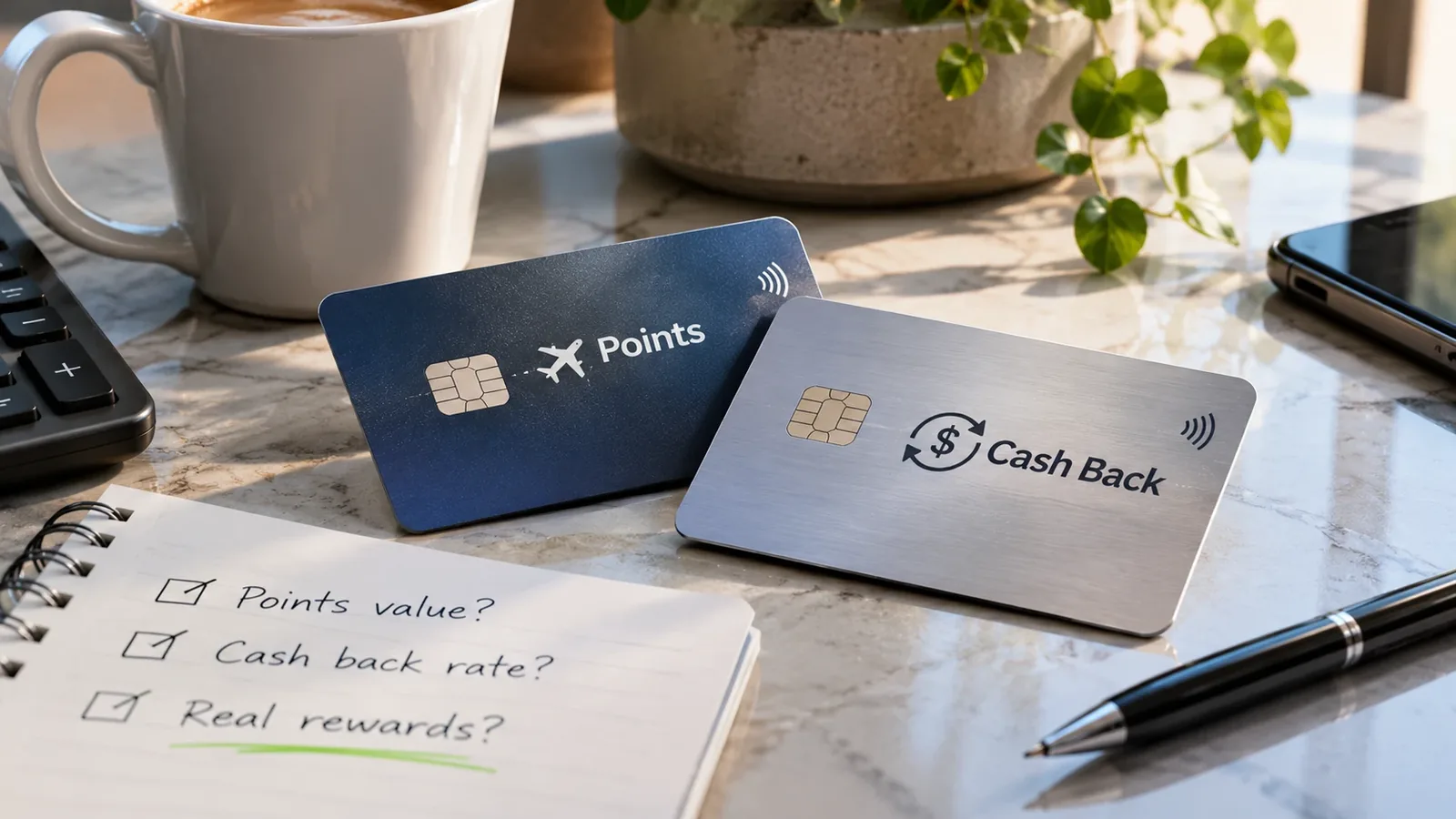
- At typical spending, the MBNA Rewards World Elite Mastercard returns $888 a year after its fee when points go to travel, and $720 when you cash them out.
- The Scotiabank Gold American Express Card returns $852 without booking travel if you redeem at Sobeys-family grocery stores. Taken as a statement credit, the same points are worth $528.
- The top cash back card in our data, the SimplyCash Preferred Card from American Express, returns $744. Only those two points cards beat it, and only when their points are redeemed well.
- Redemption matters most at TD. The TD First Class Travel Visa Infinite Card returns $497 through Expedia For TD, and $179 if you use the points to pay off everyday purchases.
Checked November 2026
How we ran the numbers
We started from the typical monthly budget in our rewards calculator, built from Statistics Canada’s Survey of Household Spending: $700 on groceries, $250 on dining, $300 on recurring bills, $100 at the pharmacy, $300 on fuel, $150 on transit, $200 on entertainment, $200 on travel and $400 on everything else. That’s $2,600 a month, or $31,200 a year.
For each card we applied its published earn rates, including spending caps, then subtracted the annual fee. Welcome offers, insurance and perks such as lounge access are left out, so the result is what a card pays year after year on rewards alone.
Then we valued the rewards two ways. Without booking travel means the top fixed rate for cash, a statement credit, an investment deposit or store credit. At the top published rate means the highest fixed rate the program publishes, which is usually travel booked through the bank. Cash back cards pay the same either way.
What each card returns at typical spending
These are the ten cards that return the most at the top published rate, next to what the same card returns if you never book travel.
| Card | Annual fee | Without booking travel | At the top published rate |
|---|---|---|---|
| MBNA Rewards World Elite Mastercard | $120 | $720 | $888 (2.85%) |
| Scotiabank Gold American Express Card | $120 | $852 | $852 (2.73%) |
| SimplyCash Preferred Card from American Express | $119.88 | $744 | $744 (2.38%) |
| National Bank World Elite Mastercard | $150 | $570 | $714 (2.29%) |
| American Express Cobalt Card | $191.88 | $702 | $702 (2.25%) |
| Neo World Elite Mastercard | $149 | $679 | $679 (2.18%) |
| CIBC Dividend Visa Infinite Card | $120 | $636 | $636 (2.04%) |
| Meridian Visa Infinite Cash Back Card | $99 | $621 | $621 (1.99%) |
| Desjardins Cash Back World Elite Mastercard | $100 | $608 | $608 (1.95%) |
| Scotia Momentum Visa Infinite + Card | $120 | $606 | $606 (1.94%) |
Percentages are the net return on $31,200 of yearly spending. Welcome offers, perks and interest are not included.
The MBNA Rewards World Elite Mastercard leads because it earns 5 points per $1 on groceries, restaurants, digital media, and memberships and household utilities, up to $50,000 a year in each, and its points are worth 1¢ on travel. Cash them out instead, at 120 points per $1, and it still returns $720.
The Scotiabank Gold American Express Card is the steadiest. Scene+ points are worth 1¢ on travel and at Sobeys-family grocery stores, so it returns $852 either way. The catch is the Points for Credit statement credit, where 150 points buy $1 and the same year falls to $528.
Cash back cards fill most of the list. The SimplyCash Preferred pays 4% on groceries and gas and 2% on everything else, for $744 with no redemption choices to get wrong.
Where your redemption choice costs the most
The gap between the two columns is the price of convenience. It’s widest on programs that pay much less for anything other than travel.
| Program | Without booking travel | At the top published rate |
|---|---|---|
| TD Rewards | 0.25¢ paying off everyday purchases | 0.5¢ on Expedia For TD |
| RBC Avion | 0.58¢ through Avion Rewards Pay | 1¢ on travel through RBC |
| RBC ION and ION+ accounts | 0.58¢ | 0.58¢ |
| BMO Rewards | 0.5¢ on non-travel purchases | 0.67¢ on travel purchases |
| National Bank À la carte | 0.4¢ on the card balance, 0.83¢ into an RRSP, TFSA or FHSA | 1¢ through À la carte Travel |
| MBNA Rewards | 0.83¢ on the World Elite, 0.5¢ on the Platinum Plus | 1¢ on travel |
| CIBC Aventura | 0.625¢ on the card balance, 0.83¢ on CIBC loans or a TFSA or RRSP | 1¢ on Flexible Travel, up to about 2.3¢ on the flight chart |
| Scene+ | 0.67¢ as a statement credit, 1¢ on groceries | 1¢ on travel |
| American Express Membership Rewards | 1¢ as a statement credit | 1¢ as a travel credit |
TD is the starkest case. The TD First Class Travel Visa Infinite Card returns $497 a year if you book through Expedia For TD, where 200 points buy $1. Use the same points to pay off everyday purchases, at 400 points per $1, and it returns $179. That’s $318 a year for the same spending.
RBC Avion and BMO Rewards follow the same pattern. The RBC Avion Visa Infinite returns $198 on travel and $64 through Avion Rewards Pay. The BMO eclipse Visa Infinite Card returns $536 on travel purchases and $372 on anything else. At National Bank, paying the card balance with points drops the World Elite to $196, while an RRSP, TFSA or FHSA contribution keeps it at $570.
RBC ION and ION+ points are worth about 0.58¢ either way, because ION accounts get a lower travel rate than other Avion cards. That puts the RBC ION+ Visa at $397 a year, a solid return for a $48 fee but well behind the cards above.
Points with no fixed value
Aeroplan, Marriott Bonvoy and partner airline miles don’t publish a fixed value, so they can’t be ranked on the same footing. At our estimate of 1.5¢ per Aeroplan point, the CIBC Aeroplan Visa Infinite Card and the TD Aeroplan Visa Infinite Card return $419 a year each. Neither has a fixed cash option.
Those figures can swing either way. A flight at a low points price can beat 1.5¢, and a poor redemption can fall below 1¢. American Express Membership Rewards points can also move to Aeroplan at 1,000 to 1,000; check which partners your card allows on our points transfer map.
Premium cards lean on perks. Among cards with fees of $399 or more, the Scotiabank Platinum American Express Card returns $297 a year on rewards alone at typical spending, and the BMO eclipse Visa Infinite Privilege Card $105. The rest return $58 or less, so lounge access, travel credits and insurance have to cover the fee.
Which card fits how you redeem
- If you’ll never book travel through a bank, choose a card that pays full value without it: a cash back card such as the SimplyCash Preferred, the Scotiabank Gold American Express Card if you shop at Sobeys-family stores, or the American Express Cobalt Card at 1¢ a point on statement credits.
- If you book travel and will use the bank’s own travel service, MBNA Rewards and National Bank À la carte pay 1¢ a point, and the MBNA Rewards World Elite Mastercard returns the most in our data.
- If you hold TD Rewards points, redeem them on Expedia For TD. Paying off purchases with them halves their value.
- If a card’s value rests on a flight chart or transfer partners, compare it with a plain 2% cash back card before you commit.
Your spending won’t match our budget exactly. The rewards calculator runs the same maths on your own numbers, and the points value calculator shows what a balance is worth by redemption.
Frequently Asked Questions
Are credit card points worth more than cash back in Canada?
Only if you redeem them well. At typical spending, just two points cards in our data beat the top cash back card, the SimplyCash Preferred at $744 a year after its fee, and only when their points go to travel or Sobeys-family groceries. Cashed out, most points cards return less than a strong cash back card.
What is the best rewards credit card in Canada?
It depends on how you redeem. On our typical $2,600 monthly budget, the MBNA Rewards World Elite Mastercard returns the most at its top published rate, $888 a year after the fee. Without booking travel, the Scotiabank Gold American Express Card leads at $852.
How much is a TD Rewards point worth?
0.5¢ on travel booked through Expedia For TD (200 points per $1), about 0.44¢ when you pay off a travel purchase (225 points per $1) and 0.25¢ when you pay off an everyday purchase (400 points per $1).
How much are RBC Avion points worth?
1¢ on travel booked through RBC for Avion Elite and Premium cards, and about 0.58¢ for RBC ION and ION+ accounts (172 points per $1). Avion Rewards Pay gives $58 per 10,000 points on most cards and $100 on Avion Privilege and Private Banking cards.
What are Scene+ points worth on a Scotiabank card?
1¢ on travel charged to the card or booked through Scene+ Travel, and 1¢ at participating grocery stores. A Points for Credit statement credit pays less: 3,000 points for $20, or about 0.67¢.
Is it worth redeeming points for a statement credit?
Only where the statement credit pays the full rate, as with American Express Membership Rewards and Brim at 1¢ a point. On TD Rewards, RBC Avion, BMO Rewards and National Bank, a statement credit or balance payment is worth much less than travel.
Do welcome bonuses change the results?
In the first year, often. We left them out because they pay once, while this study measures what a card returns every year. A large welcome offer can outweigh several years of the gap between two cards, so weigh the offer and its spending requirement too.
Why aren’t Aeroplan cards in the main ranking?
Aeroplan has no fixed point value, because flight prices in points move with demand. At our 1.5¢ estimate, the CIBC and TD Aeroplan Visa Infinite cards return $419 a year each after the fee, below every card in the top ten.
How did you choose the spending budget?
It’s the default in our rewards calculator, built from Statistics Canada’s Survey of Household Spending: each category’s average yearly household spending, divided by 12 and rounded to the nearest $25. It comes to $2,600 a month.
Try this next
Sources, checked November 2026
- creditlab.ca creditlab.ca
- Pay Off Purchases with TD Rewards Points td.com
- CIBC Payment with Points cibc.com
- Avion Rewards: travel redemption rates avionrewards.com
- Avion Rewards Pay FAQ avionrewards.com
- MBNA Rewards World Elite Mastercard mbna.ca
- National Bank: use rewards points for travel nbc.ca
- BMO eclipse Visa Infinite rewards document bmo.com
- Scotiabank Scene+ points calculator scotiabank.com
- American Express Membership Rewards americanexpress.com
- Brim features brimfinancial.com
- Laurentian Bank Visa Infinite laurentianbank.ca
- pcfinancial.ca pcfinancial.ca
- bmo.com bmo.com
- WestJet Rewards: redeem westjet.com
- BMO VIPorter World Elite rewards document bmo.com
- creditlab.ca creditlab.ca
- Scotiabank American Express Card scotiabank.com
- americanexpress.com americanexpress.com
General information for Canadians, not financial, tax or legal advice. Rules and menus change, so confirm details with your bank, lender or the Government of Canada. See our methodology.