
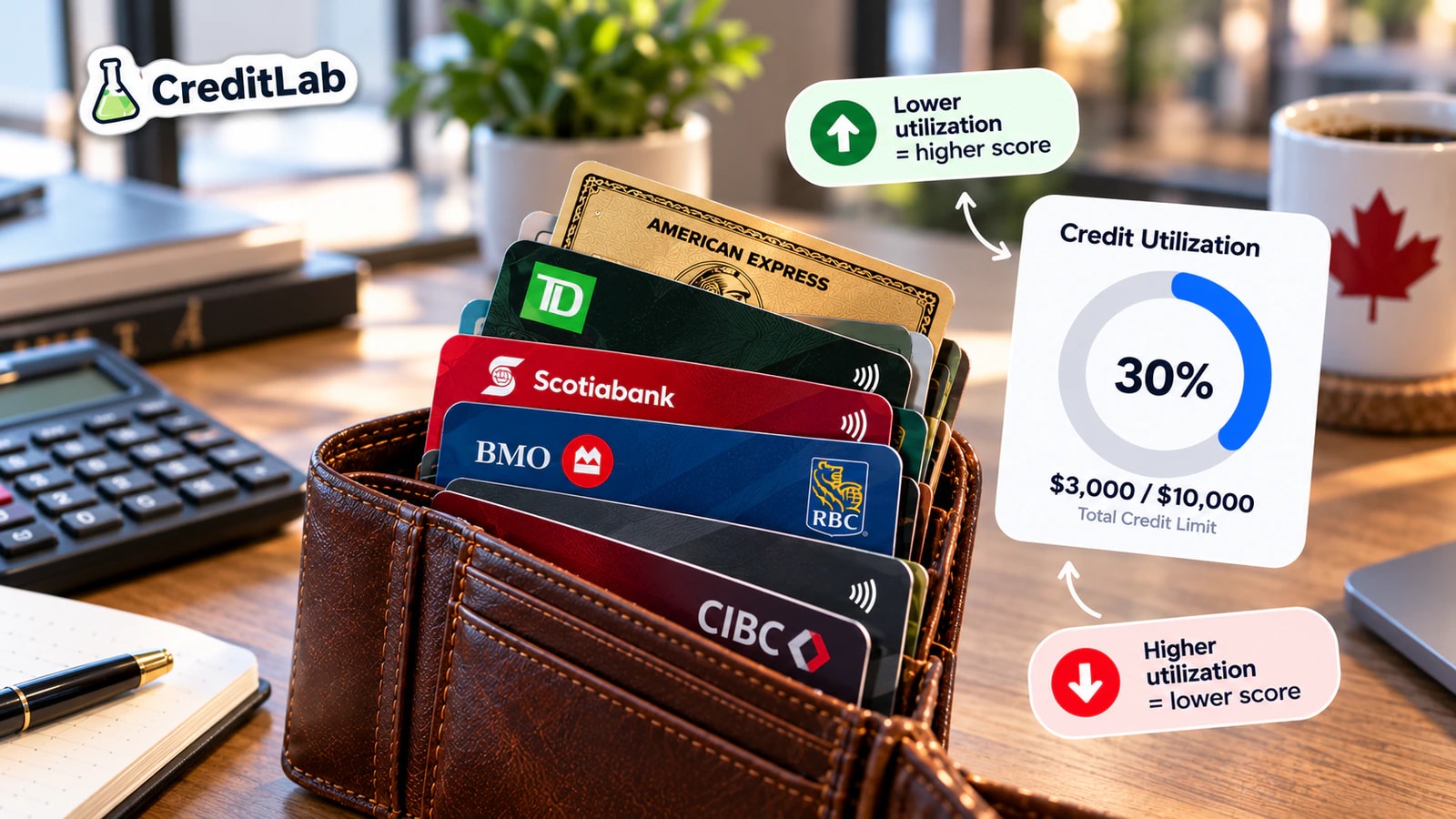
- Credit utilization is your balance divided by your credit limit, times 100: $300 on a $1,000 limit is 30%.
- FCAC advises using less than 30% of your total credit limit, and lower is better.
- Equifax says card issuers report your balance once a month, so paying before that point can lower the figure the bureaus see.
- Equifax notes that individual accounts can also be factored in, so one maxed-out card can matter even when your overall ratio is low.
Checked October 2026
What credit utilization means
FCAC describes your credit utilization rate, also called your credit use, as how much credit you use compared to your credit limit. Equifax Canada puts it more simply: how much of your available credit you’re actually using.
It applies to revolving credit, where you can borrow, repay and borrow again: credit cards and lines of credit. Lenders read a high ratio as a sign you may be stretched. FCAC says they may see high usage as higher risk even when you pay your balance in full every month.
Equifax says high utilization can lower your credit score and low utilization can help it. It’s one of several factors, alongside payment history and the length of your credit history. Our Lab note on what a good credit score is covers the full picture.
How to calculate your ratio
The formula is the same for one card or all of them.
- Add up your balancesUse the balance on each credit card and line of credit, as shown on your statement or in your app.
- Add up your limitsUse the credit limit on each of the same accounts.
- Divide and multiply by 100Equifax’s example: a $300 balance on a $1,000 limit is ($300 ÷ $1,000) x 100 = 30%.
FCAC gives a second example: if your total limit is $5,000 and you’ve used $1,000, your ratio is 20%.
Per card and overall
Your overall ratio is all your balances divided by all your limits. But Equifax notes that the utilization of individual accounts can also be factored into credit score calculations. So a card near its limit can weigh on your score even if your other cards are nearly empty.
The 30% guidance
There’s no single official cut-off, but two sources give a number.
| Source | What it says | On a $1,000 limit |
|---|---|---|
| Financial Consumer Agency of Canada | Try to use less than 30% of your total credit limit | Under $300 |
| Equifax Canada | Lower utilization can help your score; no target given | No figure |
Checked October 24, 2026. FCAC’s guidance is for your total limit; TransUnion’s example uses a single card.
Treat these as ceilings, not targets. FCAC also suggests aiming for a higher credit limit and using only a small portion of it.
Why timing matters
Equifax says card issuers report your balance to the credit bureaus once a month. That snapshot isn’t necessarily taken on your due date. Your statement closes at the end of the billing period, and FCAC says the grace period of at least 21 days starts then. You can pay in full by the due date, owe no interest, and still have a high balance reported.
That’s why FCAC says to keep your monthly utilization low even if you pay the full balance. The fix is to pay during the billing cycle. Equifax says making several payments per billing cycle can lower the balance that gets reported.
Worked example: two cards
Say you carry $1,500 on Card A, which has a $2,000 limit, and $400 on Card B, which has a $5,000 limit.
| Account | Balance | Limit | Utilization |
|---|---|---|---|
| Card A | $1,500 | $2,000 | 75% |
| Card B | $400 | $5,000 | 8% |
| Overall | $1,900 | $7,000 | About 27% |
CreditLab arithmetic.
Overall you’re under FCAC’s 30% line, which would be $2,100. But Card A on its own is at 75%.
- Pay $1,000 on Card A before its statement closes and your overall balance drops to $900 of $7,000, about 13%.
- If Card A’s limit rose to $4,000, it would sit at 37.5% and your overall ratio would fall to about 21%, without paying anything extra.
Ways to lower your ratio
- Pay more than the minimum. Equifax lists this first after spending less.
- Make several payments each billing cycle, so less is owing when your issuer reports.
- Ask for a higher limit. FCAC says if you’re often close to your limit, ask your financial institution for an increase. Equifax adds that it helps only if your payment history is good and you don’t spend more.
- Keep older cards open, so their limits stay in your total.
- Pay down card debt faster with a balance transfer or a line of credit at a lower rate, while keeping the old cards open.
Asking for a higher limit or a new card may involve a credit check. FCAC warns that too many inquiries close together can make lenders think you urgently need credit, so space out applications. If you’re building credit from scratch, a secured credit card works the same way: its limit is the denominator. Check your credit report to see the balances and limits the bureaus have on file, and use the credit card interest calculator to see what a carried balance costs.
Frequently Asked Questions
What is a credit utilization ratio?
It’s the share of your available revolving credit you’re using: your balances divided by your credit limits, times 100. $300 owed on a $1,000 limit is 30%.
What is a good credit utilization ratio?
FCAC suggests using less than 30% of your total credit limit. Lower is generally better.
Is credit utilization calculated per card or overall?
Both can matter. Your overall ratio uses all your limits, and Equifax says individual accounts can also be factored into score calculations.
Does paying in full each month keep my utilization low?
Not always. Equifax says issuers report your balance once a month, which may be before you pay. FCAC says to keep monthly utilization low even if you pay in full.
When is my balance reported to Equifax and TransUnion?
Equifax says card issuers report balances once a month. The exact date depends on your issuer, so ask them if timing matters to you.
Will asking for a credit limit increase help?
A higher limit lowers your ratio if your balance stays the same. FCAC suggests asking for an increase if you’re often close to your limit. The request may involve a credit check.
Does closing a credit card hurt my utilization?
It can. Closing a card removes its limit from your total available credit, so the same balances make up a larger share. Equifax suggests keeping older cards open.
Do lines of credit count toward utilization?
Yes. Equifax includes credit cards and credit lines when it talks about spending less to lower utilization.
How fast does lowering utilization improve my score?
Utilization reflects your most recently reported balances, which issuers send monthly. Once lower balances are reported, the change can show up on your next credit report.
Is zero utilization the best?
None of our sources says zero is ideal. FCAC’s advice is to have a higher credit limit and use only a small portion of it.
Try this next
Sources, checked October 2026
- FCAC: Improving your credit score canada.ca
- FCAC: How credit cards work canada.ca
- Equifax Canada: What is credit utilization? equifax.ca
- TransUnion Canada: What is a credit score and how is it calculated? transunion.ca
General information for Canadians, not financial, tax or legal advice. Rules and menus change, so confirm details with your bank, lender or the Government of Canada. See our methodology.