
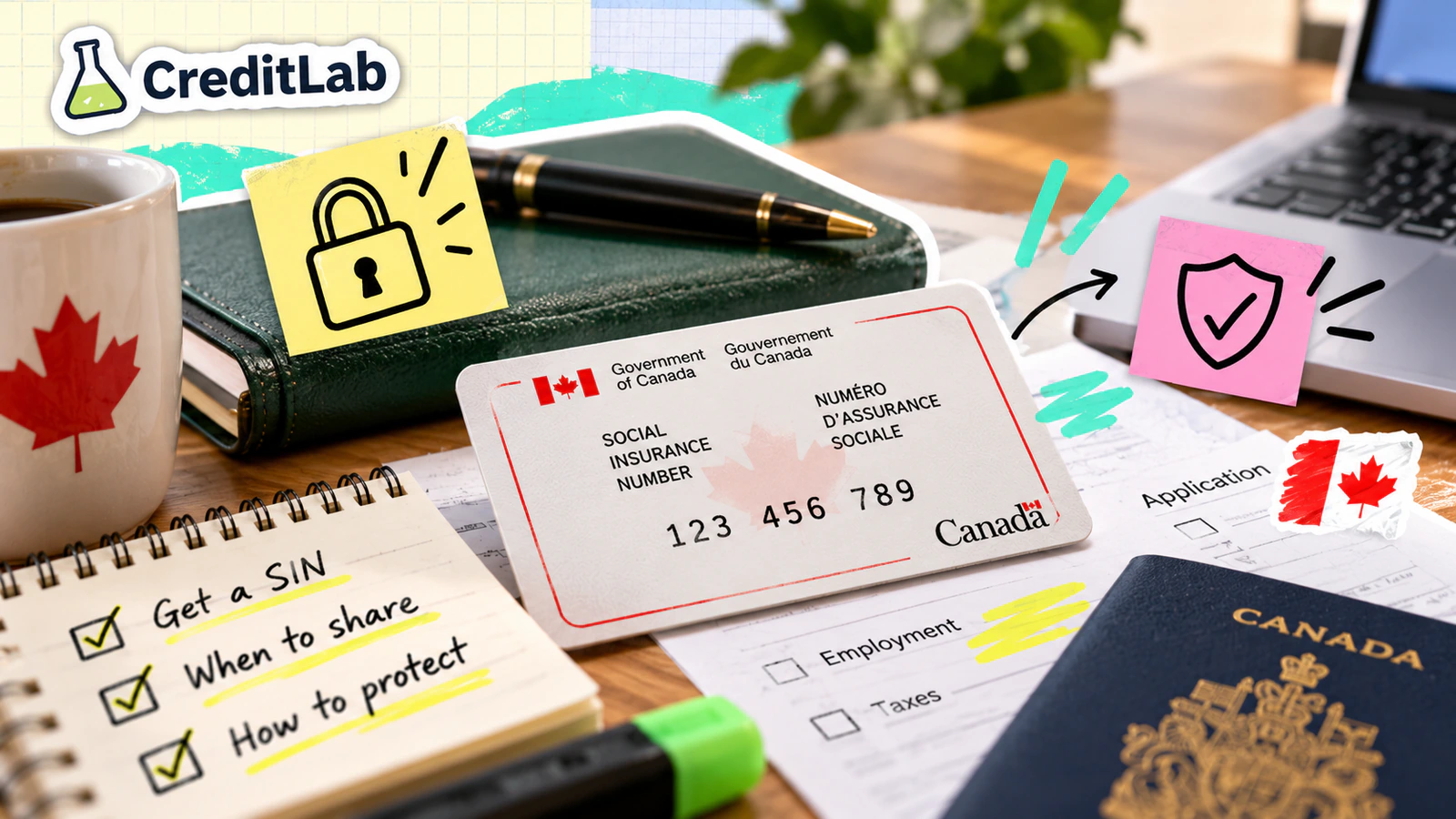
- A SIN is a 9-digit number, and applying for one through Service Canada is free.
- The government stopped issuing physical SIN cards in 2014. You now get a confirmation letter, on paper or digitally.
- A temporary resident’s SIN starts with 9 and expires on the same date as their work permit, study permit or visitor record.
- Landlords, credit card issuers and most businesses can’t require your SIN, and you can’t be refused a service for declining when the law doesn’t require it.
Checked October 2026
What a SIN is
Your social insurance number is a 9-digit number the Government of Canada uses to link you to your income and your benefits. You need one to work in Canada and to access government programs such as Employment Insurance, student loans and grants, and public pensions.
Service Canada says your SIN is private, that it’s illegal for others to use it, and that protecting it is your job. It isn’t an identity document either. No one should use it to identify you, so offer a passport or driver’s licence when someone wants ID.
A SIN issued to a Canadian citizen or permanent resident is permanent and doesn’t expire. A SIN issued to a temporary resident always starts with 9 and has an expiry date, covered below.
How to apply for a SIN
There’s no fee to apply. You can apply online, which Service Canada says is faster, by mail, or in person at a Service Canada office. In person, if your documents are in order, you get your SIN during the visit. By mail, your original documents come back to you by mail.
- Gather a primary documentThis proves your status in Canada. The table below shows what each group needs.
- Add a secondary documentAdults (the age of majority in your province or territory) also need one, such as a passport, a provincial or territorial ID card or a driver’s licence.
- Bring proof of any name changeIf your name differs from your primary document, add a supporting document showing your original and new name.
- Apply online, by mail or in personComplete and sign the application. Temporary residents mailing theirs send it to the Social Insurance Registration Office in Bathurst, New Brunswick.
| Who you are | Primary document |
|---|---|
| Canadian citizen born in Canada | Birth certificate from the vital statistics agency of the province or territory of birth |
| Canadian citizen born abroad | Certificate of Canadian citizenship, or a Certificate of Registration of Birth Abroad issued before 1977 |
| Permanent resident | Permanent Resident Card, Confirmation of Permanent Residence (within one year of landing) or a Record of Landing issued before June 28, 2002 |
| Temporary resident | A valid work permit, study permit or visitor record from IRCC that authorizes you to work. IRCC emails aren’t accepted |
Parents or legal guardians can apply for a child. For a newborn, you can apply through your province’s newborn registration service. In the territories, you apply to Service Canada directly.
SIN cards and confirmation letters
The government stopped issuing physical SIN cards in 2014. Instead, you get a confirmation of SIN letter, handed to you in person, mailed, or as a digital letter through My Service Canada Account. If you still have a plastic SIN card, you can keep using it.
If your card is damaged but you know your number, you don’t need to do anything. If you can’t find your number at all, you can request a Confirmation of SIN. It confirms your existing number; you won’t get a new one.
Temporary SINs that start with 9
If you’re in Canada on a work permit, study permit or visitor record that lets you work, your SIN starts with 9. It expires on the same date as that permit or record.
When you get a new permit with a new expiry date, update your SIN record with Service Canada. If you’ve applied to extend your permit and are waiting for IRCC to decide, you can keep working with your expired SIN until the decision.
Who can ask for your SIN
Only some organizations need your SIN by law. Plenty of others ask anyway. Service Canada says businesses asking is strongly discouraged but not illegal, and you can’t be denied a product or service for refusing when the law doesn’t require it.
| Situation | Must you give your SIN? | Why |
|---|---|---|
| Employer, after you’re hired | Yes | To report your income for tax and social benefits |
| Bank or investment company | Yes, for accounts that pay income | To report interest and dividends to the CRA |
| Government programs and your tax return | Yes | Employment Insurance, pensions, student aid, taxes |
| Job application | No | Only needed once you’re hired |
| Credit card, mortgage or line of credit application | No | Not required by law |
| Landlord or rental application | No | Not required by law |
| Phone, internet, cable or car rental | No | Not required by law (Hydro-Québec is the exception for utilities) |
| Retailers and other businesses | No | Strongly discouraged but not illegal to ask |
| Requesting your own credit report | No | Not required by law |
If someone asks without a legal reason, say it isn’t required by law and offer other ID. If they still refuse service, speak to the person in charge, or complain to the Office of the Privacy Commissioner of Canada.
Why your bank asks for it
Banks and investment firms report the interest and dividends you earn to the Canada Revenue Agency on tax slips such as the T5, the same way your employer reports your pay on a T4. The CRA says you must give your SIN to anyone who prepares your information slips, including your bank or investment company. If you don’t, you may have to pay a $100 penalty.
That’s why opening a savings account, a GIC, an RRSP or a TFSA usually means handing over your SIN. Giving it for a loan or credit card application is different: Service Canada says the law doesn’t require it, so it’s your choice.
If your SIN is lost, stolen or misused
Service Canada lists these steps if you think someone has your SIN or is using it:
- File a police report. Get the case number and the officer’s name and phone number. The report must show your name and your SIN or its last 3 digits.
- Report it to the Canadian Anti-Fraud Centre at 1-888-495-8501.
- Call TransUnion Canada (1-800-663-9980) and Equifax Canada (1-800-465-7166). Get your credit report from each, look for accounts you didn’t open, and ask for a fraud alert so lenders contact you before opening new credit. Either may charge a fee.
- Tell any creditor and your bank about accounts or transactions you don’t recognize, and ask them to close accounts you didn’t open.
- Report missing or opened mail to Canada Post, and tell any government program that paid money out under your SIN.
- Call the CRA at 1-800-959-8281 for a list of employers that issued T4 slips under your SIN over the past 3 years. A notice of reassessment for income you didn’t earn can be a sign of misuse.
A new SIN is rare. The SIN Program can’t issue one without proof your number was used to commit fraud, you must apply in person at a Service Canada Centre, and approval isn’t guaranteed. A new number doesn’t erase the old one or fix your credit file.
How to find your SIN
The quickest way is My Service Canada Account, where you can view and print your SIN. You must be at least 12 to register, and no one else can create the account for you.
Your full number is also on your past income tax returns, tax slips such as a T4, a Record of Employment and RRSP contribution receipts. Your Notice of Assessment shows only the last 4 digits, so it won’t give you the whole number.
Frequently Asked Questions
What is a SIN number in Canada?
It’s your social insurance number, a 9-digit number issued by Service Canada that you need to work in Canada and to access government programs and benefits.
How much does it cost to get a SIN?
Nothing. Service Canada charges no fee to apply for a SIN, online, by mail or in person.
Can I still get a SIN card?
No. The government stopped issuing physical SIN cards in 2014. You get a confirmation of SIN letter instead, on paper or digitally through My Service Canada Account. Old plastic cards can still be used.
How fast can I get a SIN?
If you apply in person and your documents are in order, you get your SIN during the visit. Online applications are processed faster than mailed ones, though Service Canada doesn’t publish a set time.
What does a SIN starting with 9 mean?
It’s a temporary resident’s SIN. It expires on the same date as the holder’s work permit, study permit or visitor record, so it must be updated when a new permit is issued.
Does my landlord need my SIN?
No. Service Canada says you don’t have to give your SIN to rent a property, fill out a rental application or negotiate a lease.
Why does my bank want my SIN?
Banks report interest and dividends you earn to the CRA on tax slips such as the T5. The CRA says you must give your SIN to anyone who prepares your slips, or you may face a $100 penalty.
Do I need a SIN to apply for a credit card?
No. Service Canada says you don’t have to give your SIN to apply for a credit card, mortgage or line of credit. A lender may ask, but it’s your choice.
What should I do if my SIN is stolen?
File a police report, report it to the Canadian Anti-Fraud Centre, contact Equifax and TransUnion for your credit reports and a fraud alert, and tell your bank and creditors about anything unusual.
How do I find my SIN if I lost it?
View and print it in My Service Canada Account, or check a past tax return, a T4 slip, a Record of Employment or an RRSP contribution receipt. If you still can’t find it, request a Confirmation of SIN.
Try this next
Sources, checked October 2026
- Service Canada: Social Insurance Number (SIN) canada.ca
- Service Canada: Social Insurance Number: Apply canada.ca
- Service Canada: SIN for temporary residents canada.ca
- Service Canada: The Social Insurance Number Code of Practice canada.ca
- Service Canada: Protect your Social Insurance Number canada.ca
- Canada Revenue Agency: Social insurance number (SIN) canada.ca
- Canada Revenue Agency: T5 penalties canada.ca
- Service Canada: SIN fraud, misuse and identity theft canada.ca
- Service Canada: Damaged, forgotten or lost Social Insurance Number canada.ca
- Service Canada: View your SIN in My Service Canada Account canada.ca
- Canada Revenue Agency: Notices of assessment - NOA or NOR canada.ca
General information for Canadians, not financial, tax or legal advice. Rules and menus change, so confirm details with your bank, lender or the Government of Canada. See our methodology.