
- Your transit number and branch number are the same 5 digits, and Scotiabank calls it both on its own pages.
- Payments Canada’s electronic routing number is 9 digits: a 0, then the 3-digit institution number, then the 5-digit transit number.
- On a paper cheque the routing number prints as the transit number, a dash and the institution number, such as 00000-002 at Scotiabank.
- US ABA routing numbers are a separate 9-digit system; Canadian banks publish one only for receiving US wires.
Checked October 2026
The three numbers on every Canadian account
When an employer, the government or a biller asks for your banking information, they want three numbers. Together they tell the payment system which bank, which branch and which account.
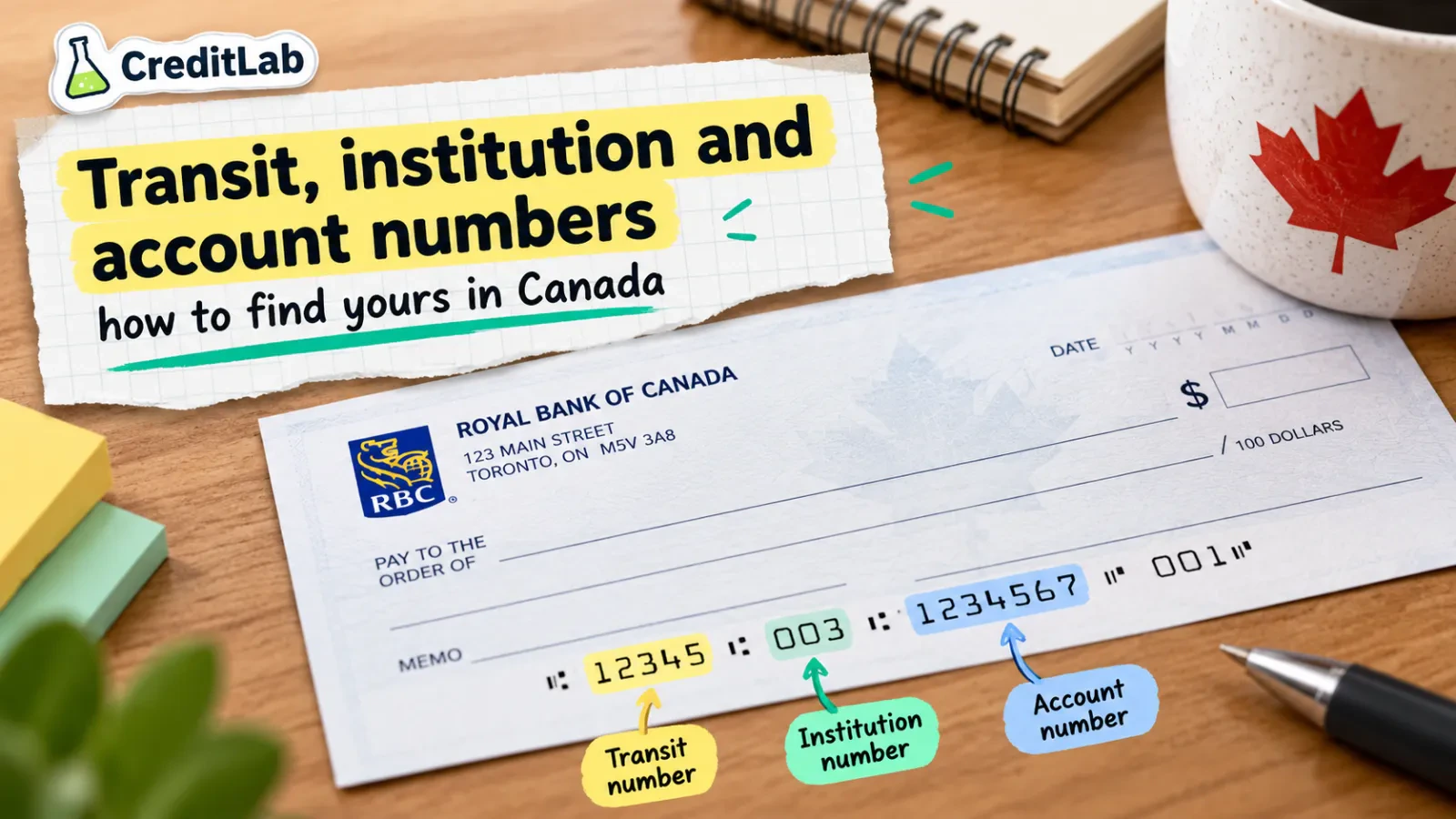
- Transit number: 5 digits that identify your branch. RBC says to include all zeros, so a transit like 01234 keeps its leading 0.
- Institution number: 3 digits that identify your bank. Scotiabank’s is 002 and CIBC’s is 010, for example.
- Account number: your own account. Length varies by bank. RBC, Scotiabank and CIBC use 7 digits, EQ Bank uses nine, and a Desjardins everyday account is 6 digits followed by the code PCA.
Scotiabank adds a useful warning: your account number isn’t the same as your debit card number. Payroll needs the account number, never the card.
Is a transit number the same as branch number?
Yes. In Canada the transit number is the branch number. Scotiabank describes it as the transit number (or branch number), Tangerine labels its own as the Transit/Branch number, and Simplii Financial calls it the branch or transit number. Payments Canada’s standards use both terms side by side.
There’s one wrinkle at TD. Its direct deposit form says your transit number will be either 4 or 5 digits. If a form asks for 5 digits and yours has 4, ask TD how to enter it rather than guessing.
What is a routing number in Canada?
A Canadian routing number is your institution number and transit number combined. Scotiabank puts it simply: the routing number represents the route to your account. Payments Canada’s branch directory lists two formats for every branch, one for electronic payments and one for paper cheques.
| Format | How it’s built | Example |
|---|---|---|
| Electronic (direct deposit, wires) | 0 + 3-digit institution + 5-digit transit = 9 digits | 001030800 (Simplii Financial) |
| Paper cheque (MICR line) | 5-digit transit, a dash, 3-digit institution | 00000-002 (Scotiabank) |
| US ABA routing number | A 9-digit US number, unrelated to the Canadian one | 026002532 (Scotiabank’s ABA) |
Payments Canada’s guide for Lynx wires gives the electronic layout and an example, 005001722, which breaks down as institution 050 and transit 01722. Its Standard 006 for cheques says the paper version has two groups of digits separated by a dash, and reading right to left they are the institution number and the branch number.
CIBC shows the electronic form in practice: its clearing code for incoming wires is 0010 followed by your 5-digit transit.
Canadian routing numbers vs US ABA numbers
If a US website or employer asks for a routing number, it means an ABA routing number. TD Bank in the US describes it as a 9-digit number used for checks and electronic payments, and it depends on where you opened your account. Canada doesn’t use that system for domestic payments.
Some Canadian banks publish an ABA number only so money can arrive from the US. Scotiabank lists 026002532 for wires from the US. RBC lists 021000021 as its ABA routing number for U.S. dollar correspondence. For a payment inside Canada, give your transit, institution and account numbers instead.
Institution numbers for major Canadian banks
These come from each bank’s own pages. Banks with branches have a different transit number at every branch, so check yours in online banking.
| Bank | Institution number | Transit number | SWIFT code |
|---|---|---|---|
| BMO | 001 | Varies by branch | Ask the bank |
| Scotiabank | 002 | Varies by branch | NOSCCATT |
| RBC | 003 | Varies by branch | ROYCCAT2 |
| TD | 004 | Varies by branch | Ask the bank |
| National Bank | 006 | Varies by branch | BNDCCAMMINT |
| CIBC | 010 | Varies by branch | CIBCCATT |
| Simplii | 010 | 30800 | CIBCCATT |
| Tangerine | 614 | 00152 | None, no wires |
| EQ Bank | 623 | 80002 | Ask the bank |
| Wealthsimple | 703 | 00001 | Ask the bank |
| Desjardins | 815 | Varies by caisse | Ask the bank |











Simplii Financial shares CIBC’s institution number 010, so its wire details name CIBC. Desjardins shows each caisse’s transit with the institution first, such as 815-20100 for Caisse Desjardins de Québec.
Where to find your numbers
- Look at a chequeScotiabank says the transit number sits at the bottom of the cheque, right before the institution number, with your account number right after it. The cheque number is at the bottom left.
- Check online banking or the appCIBC shows your account as xxxxx-yy-yyyyy in online banking: the first 5 digits are the transit and the last 7 are the account. Scotiabank and RBC show them in online banking and the app too.
- Download a void cheque or direct deposit formBoth show all three numbers. Our void cheque Lab note lists the menu path at each bank.
- Read your statementCIBC points to your eStatement as another place to find your account details.
SWIFT codes for international wires
A SWIFT code, also called a BIC, identifies a bank for international wire transfers. Payments Canada says a sender needs your institution number, transit number and account number, plus the bank’s SWIFT code if it has one.
Not every bank has one. Tangerine says it doesn’t have a SWIFT or BIC code because it doesn’t send or receive wire transfers. National Bank also notes that an IBAN only identifies European banks, so you won’t have one for a Canadian account.
Frequently Asked Questions
What is a bank routing number in Canada?
It’s your institution number and transit number combined. Electronic payments use 9 digits: a 0, the 3-digit institution number and the 5-digit transit number. On a cheque it appears as the transit number, a dash and the institution number.
Is transit number the same as branch number?
Yes. In Canada the transit number is the branch number. Scotiabank, Tangerine and Simplii Financial all use the two terms for the same 5 digits.
Is branch number the same as transit number?
Yes, they’re one number. Some forms say branch number and others say transit number, but both want the same 5 digits that identify where your account is held.
What is an institution number?
A 3-digit code for your bank. Every Canadian financial institution has its own, such as 001 for BMO, 002 for Scotiabank, 003 for RBC, 004 for TD and 010 for CIBC.
How many digits is a Canadian bank account number?
It depends on the bank. RBC, Scotiabank and CIBC use 7 digits, EQ Bank uses nine, and National Bank uses 7 for Canadian or US dollar accounts and 17 for other currencies.
What is RBC’s routing number?
RBC’s institution number is 003. Your routing number adds your branch’s 5-digit transit number, which you’ll find in online banking or on a void cheque.
Does Canada use ABA routing numbers?
Not for payments inside Canada. ABA numbers are a US system. Some Canadian banks publish one only for incoming US wires, such as Scotiabank’s 026002532.
Where is the transit number on a cheque?
Along the bottom. Scotiabank says it comes right before the institution number, and your account number follows the institution number.
Do online banks have transit numbers?
Yes, usually one for every customer. Tangerine uses 00152, EQ Bank 80002, Simplii Financial 30800 and Wealthsimple 00001.
Is it safe to give out my transit and account number?
Transit and institution numbers are public. Treat your account number like your social insurance number, as Scotiabank advises, and share it only with payers you’ve chosen.
Try this next
Sources, checked October 2026
- Payments Canada: CACPA code STP formatting best practices (March 26, 2026) payments.ca
- Payments Canada: Standard 006, Specifications for MICR-encoded payment items payments.ca
- Payments Canada: Financial institutions branch directory payments.ca
- Payments Canada: Wire payment consumer guide payments.ca
- Scotiabank: How to find your bank account details scotiabank.com
- RBC Royal Bank: Wire transfer rbcroyalbank.com
- TD Canada Trust: Direct deposit form td.com
- TD Bank (US): Direct deposit and routing numbers td.com
- BMO: Brooks branch page branches.bmo.com
- CIBC: Sending and receiving wire transfers cibc.com
- National Bank: Receiving an international transfer nbc.ca
- Desjardins: Caisse Desjardins de Québec desjardins.com
- Tangerine: Transit and institution numbers tangerine.ca
- Simplii Financial: FAQ simplii.com
- EQ Bank: Common questions eqbank.ca
- Wealthsimple: Direct deposit wealthsimple.com
General information for Canadians, not financial, tax or legal advice. Rules and menus change, so confirm details with your bank, lender or the Government of Canada. See our methodology.