
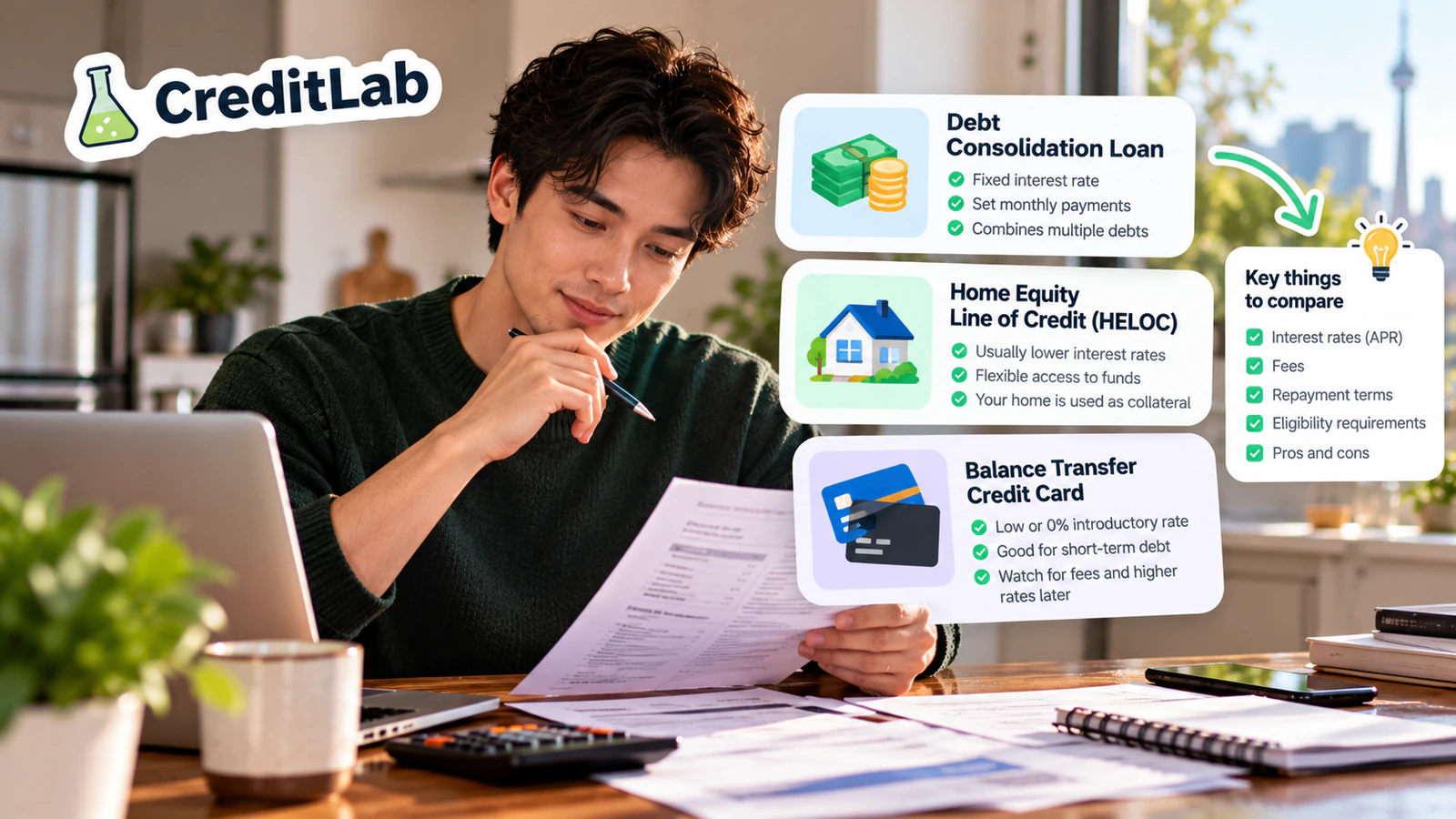
- FCAC says consolidating into a lower rate may save money, but a longer repayment period can cost more in interest over time.
- A balance transfer promo rate usually lasts 6 to 18 months, so it suits debt you can clear in that window.
- A debt management plan stays on your credit report for 2 years after you finish it, according to the OSB.
- A consumer proposal is open to people whose debts, excluding a home mortgage, don’t exceed $250,000, and it lasts up to 5 years.
Checked October 2026
What debt consolidation does
The Financial Consumer Agency of Canada (FCAC) defines debt consolidation as combining multiple debts into one, so you make 1 payment instead of many. The goal is usually a lower interest rate, a single due date, or both.
It isn’t debt relief. You still owe the full amount. FCAC is blunt about the main risk: if you keep the spending habits that caused the debt, consolidation will likely leave you owing more.
Your options, side by side
The first four options are borrowing products from a bank or lender. The last two are for people who can’t repay on their current terms.
| Option | How it works | Watch out for | Credit report |
|---|---|---|---|
| Debt consolidation loan | One lump sum pays off your debts; fixed or variable rate and a set term | A longer term can cost more interest | A new loan and a credit inquiry |
| Line of credit | Borrow up to a limit; pay interest only on what you use; usually a variable rate | Minimum payments may cover only interest | A new credit account and inquiry |
| HELOC | Borrow against your home equity, up to 65% of its value | Your home secures the debt | A new secured account; stress test to qualify |
| Balance transfer | Move card balances to a new card at a low or 0% promo rate | A transfer fee and a rate jump when the promo ends | A new card and inquiry |
| Debt management plan | A credit counsellor negotiates one monthly payment with your creditors, often with interest relief | Cards in the plan must be closed; fees aren’t regulated | Noted for 2 years after you finish |
| Consumer proposal | A Licensed Insolvency Trustee offers creditors a deal to repay part of what you owe | Debts can’t exceed $250,000, excluding your mortgage | Equifax: 3 years after completion |
Sources: FCAC and the OSB, checked October 24, 2026.
Borrowing to consolidate
A debt consolidation loan is the most direct route. FCAC notes it has regular payments, a fixed or variable rate and a set repayment period, so you know the end date. Personal loans and home equity loans can do the same job.
A line of credit is more flexible, which is also the problem. FCAC says payments may cover only the interest, and if you keep borrowing from it, getting out of debt may be difficult. Before you get one, make sure you have the discipline to pay it back.
A HELOC usually carries a lower rate because your home secures it. FCAC says you can borrow up to 65% of your home’s value this way, but you must pass a stress test at a bank, and you could lose your home if you don’t repay. Our Lab notes on a line of credit and a HELOC go deeper on both.
A balance transfer moves card debt to a new card at a low or 0% rate, usually for 6 to 18 months, for a fee that’s a percentage of the amount moved. It works well for card debt you can clear before the promo ends. Our balance transfer Lab note covers the costs and current offers.
When you can’t qualify for a loan
If your debts have outgrown your income, the OSB points to two structured options.
- A debt management plan (DMP). A credit counsellor proposes one affordable monthly payment to your creditors. FCAC says you usually repay 100% of the debt, but you may not have to keep paying interest. The OSB says a DMP lasts 1 to 5 years, and any credit card in it must be closed.
- A consumer proposal. Only a Licensed Insolvency Trustee can file one. You offer to repay part of what you owe, or take longer, over up to 5 years. Fees are regulated under the Bankruptcy and Insolvency Act, and you must attend two financial counselling sessions.
Credit counselling is offered by both not-for-profit and for-profit companies, and fees vary. FCAC says no reputable agency charges for the first meeting, and simply talking to one won’t affect your credit score. Many trustees also offer a free first consultation.
How consolidation affects your credit score
Consolidating can help your credit score. FCAC says it may improve your score if you make on-time payments and reduce the number of high-balance accounts. Paying off cards also lowers your credit utilization, the share of your limits you’re using.
It can also hurt in the short term. Applying for loans with several lenders in a short time may lower your score, so compare rates first and apply selectively. The structured options leave a longer mark: the OSB says Equifax removes a consumer proposal 3 years after you complete it, and TransUnion removes it 3 years after completion or 6 years after signing, whichever is sooner. A first bankruptcy stays for 6 or 7 years after discharge.
Check your credit report before and after so you can confirm old accounts show as paid.
Worked example: $15,000 in card debt
Say you owe $15,000 across credit cards at 20.99%. Interest in the first month is about $262.38. Paying $450 a month, you’d need 51 months and pay about $7,703 in interest.
| Approach | Monthly payment | Total interest |
|---|---|---|
| Stay on the cards at 20.99% | $450 | About $7,703 over 51 months |
| 3-year loan at 9.99% | $483.94 | $2,421.75 |
| 5-year loan at 9.99% | $318.63 | $4,117.91 |
CreditLab arithmetic. The 9.99% loan rate is an example, not a quote; your rate depends on your credit and the lender.
Both loans cost less than staying put. But the 5-year loan, with its lower payment, costs about $1,700 more in interest than the 3-year one. That’s FCAC’s point about longer repayment periods. Choose the shortest term you can afford, and model it with the debt payoff calculator.
Frequently Asked Questions
What is debt consolidation?
It’s combining several debts into one, usually with a loan, line of credit or balance transfer, so you make one payment, ideally at a lower interest rate.
How does a debt consolidation loan work?
A lender gives you a lump sum to pay off your debts. You then repay the loan with regular payments over a set period, at a fixed or variable rate.
Is a line of credit or a loan better for consolidation?
A loan has a fixed end date, which forces repayment. A line of credit is flexible, but FCAC warns that payments may cover only interest and continued borrowing makes it hard to get out of debt.
Does debt consolidation hurt your credit score?
Applying can cause a small, short-term dip, especially if you apply with several lenders close together. FCAC says it may improve your score over time if you pay on time and reduce high-balance accounts.
Can I consolidate debt with bad credit?
Possibly, but FCAC says a poor credit history may mean a higher rate, sometimes higher than your current debts. A non-profit credit counsellor can review other options with you.
What is a debt management plan?
It’s an informal arrangement a credit counsellor makes with your creditors to combine your debts into one monthly payment, often with interest relief. You usually repay the full amount over 1 to 5 years.
What is a consumer proposal?
It’s a legal process run by a Licensed Insolvency Trustee where you offer creditors a deal to repay part of what you owe, or take longer, over up to 5 years. It’s for debts up to $250,000, excluding your mortgage.
How long does a consumer proposal stay on my credit report?
The OSB says Equifax removes it 3 years after you complete it. TransUnion removes it 3 years after completion or 6 years after signing, whichever comes first.
Can I use a HELOC to consolidate debt?
Yes, if you have enough home equity and pass the stress test. The rate is usually lower, but your home secures the debt, so missed payments put it at risk.
What is the best way to consolidate credit card debt?
If you can repay within the promo period, a balance transfer at a low or 0% rate can cost less than a loan. For larger balances, a consolidation loan with the shortest term you can afford limits total interest.
Try this next
Sources, checked October 2026
- FCAC: Debt consolidation canada.ca
- FCAC: Home equity line of credit canada.ca
- FCAC: Getting help from a credit counsellor canada.ca
- OSB: Compare debt solutions ised-isde.canada.ca
- OSB: Your finances are in serious trouble ised-isde.canada.ca
- OSB: Your debts are getting out of control ised-isde.canada.ca
General information for Canadians, not financial, tax or legal advice. Rules and menus change, so confirm details with your bank, lender or the Government of Canada. See our methodology.